How to tailor your resume to a job description
Sending the same PDF to every opening is fast — and easy for hiring teams to ignore. Tailoring means shaping your resume so a reader (and often an automated screen) can see, in seconds, that your background matches this job description (JD). This guide walks through a repeatable process. It works whether you edit in Word, Notion, or a tool like CVBranch that matches your CV to a pasted JD and helps you compose a one-page version for that role. For a role-specific starting point, see our software engineer resume example.
Why tailoring beats a generic resume
Recruiters and engineering managers skim dozens of resumes per role. They are looking for overlap: title band, core stack, domain, and proof you have done work at the scope they describe. A generic resume hides that overlap under bullets written for a different audience.
Tailoring is not keyword stuffing. It is translation: same honest experience, language aligned to the posting. For backend roles that might mean leading with APIs, data stores, and reliability; for platform roles, infra and developer experience; for full-stack, product delivery and ownership across the stack.
Step 1: Extract what the JD actually asks for
Before you touch your resume, mark up the posting in three buckets:
- Must-haves — hard requirements (years of experience, languages, frameworks, cloud, security clearances, location).
- Repeated themes — phrases that appear in responsibilities and qualifications (e.g. "distributed systems," "on-call," "mentorship," "CI/CD").
- Nice-to-haves — tools mentioned once, adjacent skills, preferred degrees.
In software hiring, pay special attention to seniority signals: leading projects vs contributing, designing systems vs implementing tickets, mentoring, cross-team influence, and measurable outcomes (latency, cost, reliability, revenue, adoption).
Step 2: Map your experience — honestly
List your roles and bullets, then tag each bullet with JD themes it supports. If a must-have has no bullet behind it, you have a gap. Gaps fall into two types:
- Presentation gaps — you did the work but your resume never said it (e.g. you ran on-call but wrote "supported production" without mentioning incidents or SLOs).
- Real gaps — you have not done that work yet. Do not invent it. You can address some real gaps with training, side projects, or honest framing; others mean this role may be a stretch today.
Matching your resume to a job description is a sanity check, not a game to hit 100% on buzzwords. Use match feedback to prioritize what to clarify or strengthen — not what to fake. For a deeper read on required vs preferred and presentation gaps, see match resume to job description.
Match result
Software Engineer
Answer the 5 gaps below — your score updates after every answer.
Score breakdown
Skills
Matched required
- React
- Observability
- C#
- .NET
Missing required
- Distributed Systems
- Microservices
- Azure
- CI/CD
- OAuth 2.0
- +5 more
Missing preferred
- Agile
- Computer Science
A presentation gap often looks like a missing keyword with related experience nearby — C# on your resume when the JD asks for .NET, or AWS when it asks for Azure. Good tailoring clarifies that overlap with facts before you add a bullet.
Raise your score
5 challenges left. Each honest answer can raise your score right away — then draft a bullet and add it to lock it into your CV.
Still helpful: task, ownership, scale, outcome
Gap question
The role requires .NET. You used C# at Example Co — did you also work with .NET there or in a similar project?
yes
Follow-up
What specific .NET-related tasks did you perform at Example Co? For example: designed a .NET-based API, implemented a .NET library, or optimized .NET performance.
Step 3: Rewrite bullets for this role
Keep bullets one line when possible, start with a strong verb, and pack in scope + action + outcome. Prefer metrics you can defend in an interview.
Weak (generic): "Worked on microservices using Java and AWS."
Stronger (tailored to a backend JD): "Designed and shipped Java microservices on AWS (ECS, RDS) that cut p95 checkout latency 40% for 2M monthly orders."
Tactics that help for tech roles:
- Mirror safe terminology from the JD (their stack names, their domain words) where your experience is genuinely the same.
- Move the most relevant job higher in the bullet list; trim or shorten older, irrelevant detail.
- Put a concise Skills section near the top if the JD is stack-heavy — but only list tools you can discuss under pressure.
- Align title lines when accurate (e.g. "Senior Software Engineer" vs "Software Engineer II") without inflating level.
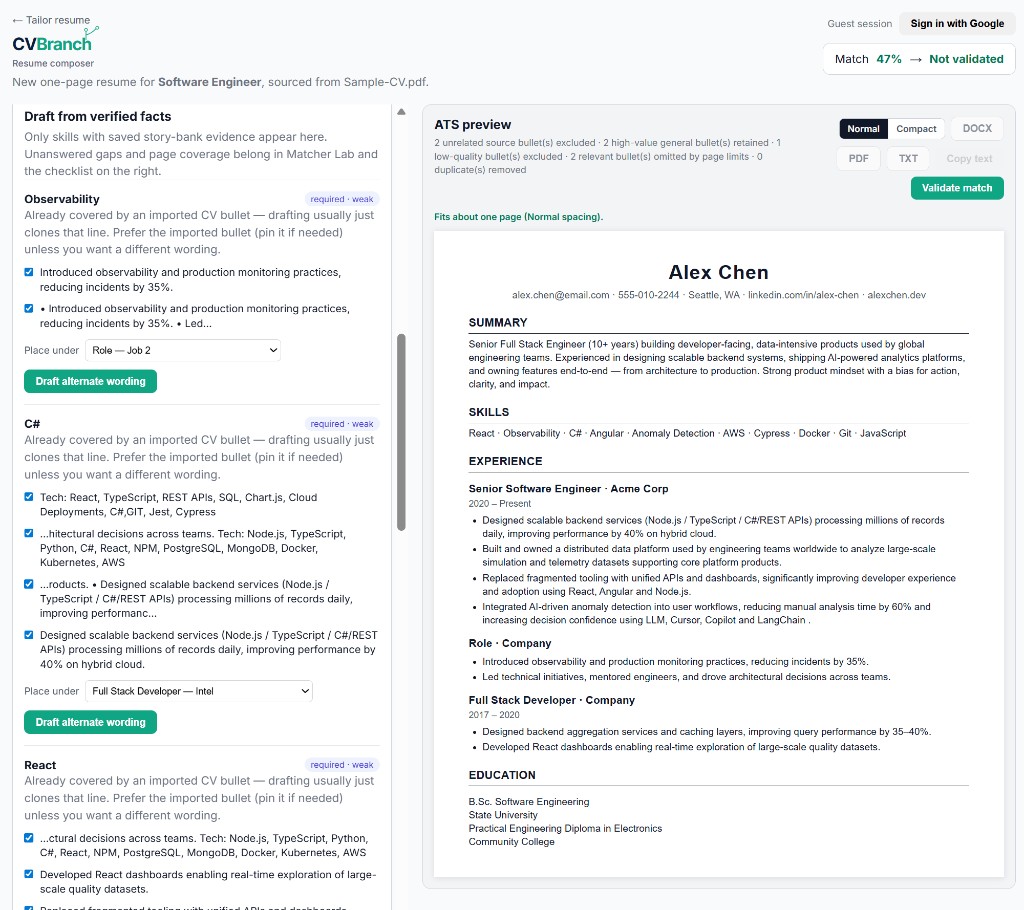
Step 4: Compose a one-page version for this application
Many tech resumes sprawl to two pages; many screeners want one page for an initial pass. For a given JD, decide what earns space:
- Lead with the role and bullets that best match the posting.
- Shorten or drop projects that do not support this track.
- Keep contact info and links (GitHub, LinkedIn) scannable.
Save this tailored version under a clear filename (YourName_Company_Role.pdf). Your master resume can stay longer; each application gets a focused export.
In CVBranch, the composer packs selected bullets and JD-aligned skills into an ATS preview and flags when the draft likely fits one page:
Common mistakes (especially in IT resumes)
- Keyword stuffing — skills lists with 40 technologies and no proof in bullets.
- Invented experience — claiming Kubernetes prod ownership because you once ran a tutorial.
- Same bullets everywhere — platform and frontend JDs need different emphasis.
- No outcomes — responsibilities without scale, metrics, or business effect.
- Ignoring soft requirements — mentorship, communication, and ownership often decide senior hires.
Where AI helps — and where you stay in charge
AI resume tools can speed up parsing a JD, comparing it to your CV, suggesting bullet rewrites, and drafting gap-interview questions. That is useful when the tool grounds suggestions in your uploaded experience — not when it fabricates projects or metrics. See also: can AI tailor my resume to a job posting? and ChatGPT prompts for resume tailoring.
CVBranch follows that line: upload your resume, paste the job description, see how you match, work through real gaps with evidence from your story bank, then compose a one-page resume for that role. Matching is deterministic; AI assists with drafting and examples. You approve every bullet before you apply.
Treat any AI output like a junior editor: check facts, tone, and seniority before you send.
Quick checklist before you submit
- Must-have skills from the JD appear in skills or bullets with proof.
- No bullet you cannot explain in a 5-minute interview story.
- File name and PDF text are readable (avoid broken export from design tools).
- Links work; dates and titles match LinkedIn within reason.
- Length fits the role — often one page for <10 years, two only if every line earns its place.
Related guides
- Match resume to job description
- Can AI tailor my resume?
- ChatGPT resume prompts
- Software engineer resume
- Senior software engineer resume
- IT resume bullet quality study
- Assess resume bullet quality
Ready to match your resume to a specific posting?
Tailor your resume with CVBranchFree guest session · Built for software and IT CVs and job descriptions