Can AI tailor my resume to a job posting?
Yes — AI can help you tailor your resume to a job description when it reads your CV and this posting, shows where you match, and drafts from facts you can defend. It fails when it invents projects, metrics, or skills you never had. For tech roles, the useful question is not "can ChatGPT rewrite my resume?" but whether the tool does AI resume tailoring grounded in your experience — or just generates plausible-sounding text.
The short answer for software and IT job seekers
Good resume tailoring AI should: parse the job description (JD), match your resume to the job description, highlight required vs preferred skill gaps, and help you optimize wording for that specific role — without adding claims you cannot explain in an interview. That is different from a one-click "make me sound senior" prompt or a generic resume optimizer that reorders buzzwords without checking your bullet list.
CVBranch is built around that workflow: upload a CV, paste the JD, see the match, work through gaps with evidence, then compose a one-page resume for that application. Matching is deterministic; AI assists with drafting — you approve every line. Try it free (guest session) or read the step-by-step tailoring guide.
What AI resume tailoring should actually do
Searchers use overlapping phrases — tailor resume to job description AI, AI resume tailor, resume tailoring AI, tailoring resume to job description — but the job is the same: align an honest CV with one posting. A capable tool typically covers four steps:
- Match — compare your skills, title band, and experience signals to the JD (required, preferred, and repeated themes).
- Gap clarity — separate presentation gaps (you did the work; the resume never said it) from real gaps (you have not done that work yet).
- Draft with evidence — suggest bullet rewrites and skill lines tied to your uploaded history, not invented employers or stack.
- Compose for this application — pack the strongest, verified bullets into a focused one-page version for that role.
That is resume optimization in the honest sense: same career, better alignment and clearer proof — not a fictional second resume.
Match result
Software Engineer
Answer the 5 gaps below — your score updates after every answer.
Score breakdown
Skills
Matched required
- React
- Observability
- C#
- .NET
Missing required
- Distributed Systems
- Microservices
- Azure
- CI/CD
- OAuth 2.0
- +5 more
Missing preferred
- Agile
- Computer Science
Raise your score
5 challenges left. Each honest answer can raise your score right away — then draft a bullet and add it to lock it into your CV.
Still helpful: task, ownership, scale, outcome
Gap question
The role requires .NET. You used C# at Example Co — did you also work with .NET there or in a similar project?
yes
Follow-up
What specific .NET-related tasks did you perform at Example Co? For example: designed a .NET-based API, implemented a .NET library, or optimized .NET performance.
Generic AI (ChatGPT, etc.) vs JD-grounded tailoring
Generic AI rewrite
- Prompt: "Tailor my resume for this Software Engineer job"
- Often invents metrics, tools, or project scope
- No structured match score or gap list
- Same output quality for every industry
- You proofread everything from scratch
AI resume tailor (JD + your CV)
- Parses this JD and your uploaded CV
- Shows matched vs missing required / preferred skills
- Asks gap questions before drafting new claims
- Drafts bullets from verified facts and selected lines
- Composes a one-page version for that application
Paste-only workflows can still help you brainstorm wording — see ChatGPT prompts for resume tailoring for copy-paste prompts with evidence-only rules. They are risky as your only tailor resume to job description AI step because the model does not know what is already on page two of your PDF, what you actually shipped, or which JD skills are must-haves vs nice-to-haves.
AI resume tailor vs resume optimizer vs job matcher
Vendors use different labels; for SEO and shopping you will see all of these. On a single honest workflow they map roughly like this:
- AI resume tailor / resume tailoring AI — emphasis on rewriting for a specific JD (language, bullets, skills order).
- Resume optimizer — emphasis on clarity, length, and impact; should still be JD-aware for applications, not only generic polish.
- Match resume to job description — emphasis on overlap and gaps before you edit; the sanity check that stops keyword stuffing. See match resume to job description.
CVBranch combines all three in one product at cvbranch.com — not separate "matcher" and "optimizer" apps. Avoid tools that promise a high match score while encouraging invented keywords you cannot defend.
When AI tailoring helps most (tech roles)
- You apply to many similar but not identical postings (backend vs platform vs full-stack emphasis).
- Your master resume is two pages and you need a one-page version per application.
- The JD uses different words for the same work (e.g. .NET vs C#, Azure vs AWS) and you need help surfacing presentation gaps.
- You want draft bullet variants faster — but only from bullets and gap answers you already own.
AI helps less when you are changing careers with no overlapping evidence, or when you want the tool to fabricate seniority. In those cases, fix the underlying story first; do not prompt your way into a role you cannot discuss for forty-five minutes.
How to evaluate AI resume tailoring tools
Before you trust any best AI for resume tailoring list, check:
- Does it require your resume file or text, not just a job link?
- Does it show required vs preferred skills separately?
- Does it distinguish missing skills from skills you already have under another name?
- When it drafts a new bullet, can you trace it to a fact you provided?
- Do you approve exports, or does it auto-apply fiction?
- Is it scoped honestly (e.g. software/IT) rather than "any job, any industry"?
Free tiers (tailor resume to job description AI free searches) are fine for trying the match-and-compose flow — judge quality on evidence grounding, not on how flashy the rewrite sounds.
What CVBranch does (and does not) claim
CVBranch is an AI resume tailor for software and IT CVs and job descriptions. It analyzes your resume against a pasted JD, identifies skill gaps, runs gap-interview questions when evidence is missing, and helps you compose a one-page resume for that role. It is not marketed as an ATS resume checker or a guarantee of interviews — it helps you tailor and optimize text you can stand behind.
Step 4 in the workflow — compose a focused export for this application, with an ATS preview and one-page fit check:
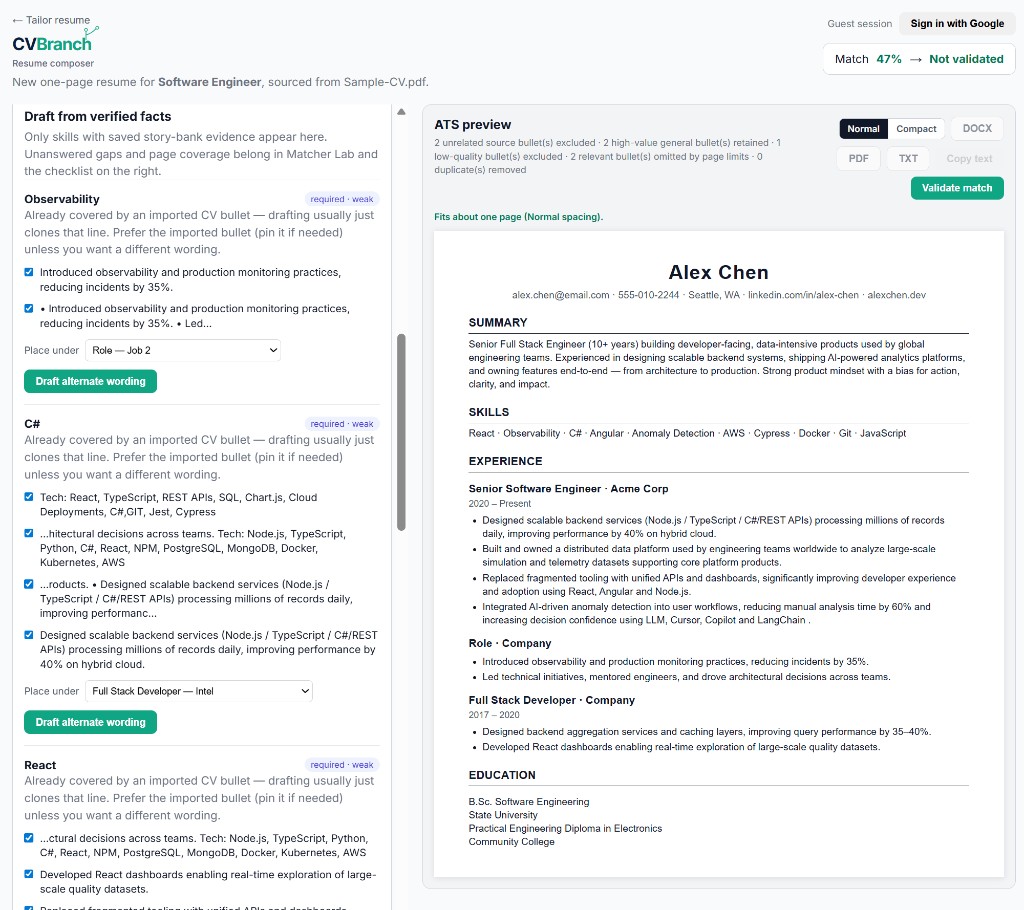
For the full manual process (extract JD themes, map bullets, rewrite, compose), see how to tailor your resume to a job description.
Quick checklist: safe AI tailoring
- Every new skill on the tailored resume appears in a bullet or gap answer you wrote.
- Metrics and scope match what you would say aloud to a hiring manager.
- Must-have JD terms are covered with proof, not only in a skills list.
- You kept a master resume; this file is named for the company and role.
- You treated AI output as a draft — same as a human editor.
Related guides
- Tailor resume to job description
- Match resume to job description
- ChatGPT resume prompts
- Software engineer resume
- Senior software engineer resume
- IT resume bullet quality study
- Assess resume bullet quality
Ready to match your resume to a job posting with evidence?
Tailor your resume with CVBranchFree guest session · AI resume tailoring for software and IT CVs and job descriptions